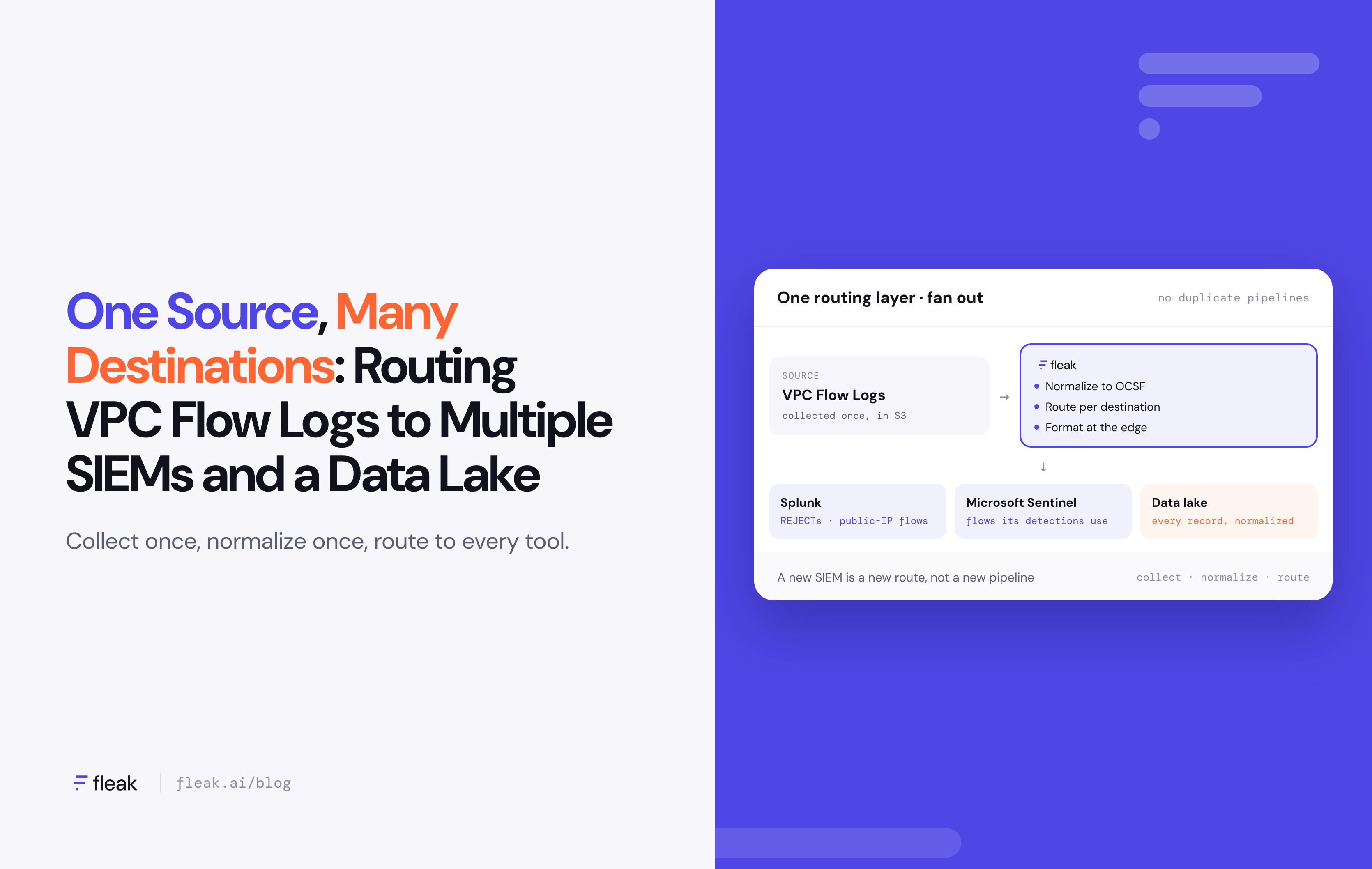
The short answer: the best way to route VPC Flow Logs to multiple SIEMs or a data lake is to collect them once and fan them out from a single log routing layer. That layer normalizes each record, decides which destinations need it, and sends each one only what it uses. You avoid duplicate pipelines, duplicate costs, and the drift that comes from maintaining the same logic in several places.
Not long ago, most security teams had one SIEM, and every log went there. That's no longer the norm. Many organizations now run Splunk alongside Microsoft Sentinel or another SIEM, feed a security data lake for threat hunting, and are starting to point AI tools at the same data.
VPC Flow Logs are often one of the first sources every one of those destinations asks for.
The instinct is to build a new pipeline each time a new destination shows up. That works for a while. Then you're paying to move the same data several times, each copy is formatted differently, and a change to one pipeline quietly breaks a detection somewhere else.
In this post, we'll cover why multi-destination routing has become standard, where the native AWS options run out, and what a log routing strategy looks like when one source has to serve many destinations.
Why one source now needs many destinations
Security leaders end up with more than one destination for network data for a few common reasons:
- SIEM migrations. Moving from one SIEM to another takes months. During that time, both need the same data so detections can be rebuilt and validated side by side.
- Mergers and acquisitions. Acquired teams often bring their own SIEM. Until the stacks are consolidated, AWS logs from both sides may need to reach both tools.
- Cost tiering. Many teams keep high-value events in the SIEM and send the full record to a lower-cost data lake for retention, investigations, and threat hunting.
- New consumers. Detection engineering platforms, XDR tools, and AI-assisted security tools increasingly want the same network telemetry.
Each destination wants something slightly different. One SIEM needs a subset of events in its own schema. Another needs a different subset in a different format. The lake needs everything, kept in a consistent structure so it can be queried later. Meeting all of those needs from one source, without rebuilding the pipeline every time, is the real problem.
Where native AWS options run out
AWS gives you the building blocks for multi-destination routing, but each one stops short of the full job. VPC Flow Logs can publish to Amazon S3, CloudWatch Logs, or Amazon Data Firehose, and Firehose can deliver to destinations including Amazon S3, Splunk, Datadog, Elastic, Snowflake, and generic HTTP endpoints.
|
Approach |
How it works |
The limitation |
|---|---|---|
|
A separate flow log per destination |
Configure flow logs to each destination independently |
Every copy carries its own delivery charges, and changes have to be made in several places |
|
One Firehose stream per destination |
Each Firehose stream delivers to one destination |
You manage a stream, transform, and error handling for each tool. Filtering and formatting logic is repeated in each |
|
Land in S3, let each tool pull |
Each SIEM or lake reads from the same bucket |
Every tool parses the raw format its own way. Nothing filters what each one ingests, so each pays for everything |
|
Custom Lambda fan-out |
Code reads each record and forwards it to several places |
Works, but your team now owns a custom pipeline: scaling, retries, schema changes, and on-call |
The common thread is duplication. The same parsing, filtering, and formatting logic ends up rebuilt for every destination, and each version drifts a little from the others. When one detection stops firing, it's hard to tell whether the cause is the data, the pipeline, or the tool.
What a multi-destination log routing strategy looks like
Routing VPC Flow Logs to multiple SIEMs and a data lake comes down to a few decisions. Your engineers will handle the setup, but these choices determine cost, consistency, and how easily you can add or retire a destination later.
- Collect once. Publish flow logs to one place, usually S3, and have a single pipeline read from it. Every destination is served from that one collection point.
- Normalize once. Map each record to a common schema like OCSF before it goes anywhere. Every destination then receives the same field names and meanings, so detections behave the same way in each tool and correlation works across sources.
- Route by what each destination needs. Write rules per destination. One SIEM might get rejected traffic and flows to public IPs. Another might get only the flows tied to its detections. The lake gets everything.
- Format at the edge. Convert to each destination's format as the last step, so a change in one tool's requirements doesn't ripple back through the whole pipeline.
- Make destinations easy to add and remove. A new SIEM or lake should be a new route, not a new pipeline. The same goes for retiring a SIEM after a migration.
- Measure and revisit. Track volume and cost per destination, and review the rules as detections and tools change.
This is the problem we built Fleak to solve. Fleak sits in front of your SIEMs, not in place of them. It collects VPC Flow Logs once, normalizes them to OCSF, UDM, or a custom schema, and routes each record to every destination that needs it: Splunk, Microsoft Sentinel, Google Chronicle, CrowdStrike Falcon, Palo Alto XSIAM, Databricks, Snowflake, Amazon S3, and more than 500 other integrations.
Your team describes the routing rules in plain English, and Fleak's copilot builds the pipeline. AI writes the config, but a deterministic engine runs it, so production data never passes through an AI model. When a source format changes, Fleak detects the drift and redeploys a corrected config, with an average time to heal of about three minutes, so one change doesn't break every destination at once.
What one source, many destinations looks like
With a single routing layer, the pipeline is built once and every destination hangs off it. Adding a new tool is a new route. Retiring one is removing a route.
|
Destination |
What it receives |
|---|---|
|
SIEM 1: Splunk |
Rejected traffic and public-IP flows, in Splunk's format |
|
SIEM 2: Microsoft Sentinel |
The flows its detections use, in Sentinel's format |
|
Data lake (Databricks or S3) |
Every record, normalized, for hunting and retention |
A few practices keep this working over time:
- One schema, many formats. Normalize to a single schema in the middle, and convert to each tool's format only at delivery.
- Detection-first routing. Each SIEM gets the events its detections and dashboards use, not a full copy of everything.
- The lake is the system of record. Keep the complete, normalized record there, so any tool can be backfilled or replaced without losing history.
- Change in one place. When a rule or format changes, update the routing layer once instead of every pipeline.
For security leaders, the practical result is a stack that can change, whether through a migration, an acquisition, or a new AI tool, without rebuilding how your data moves.
Questions to ask your team
- How many separate pipelines move VPC Flow Logs today, and who maintains each one?
- Are we paying to deliver or ingest the same flow logs more than once?
- Do our SIEMs and our lake see the same fields, with the same names and meanings?
- If we added or retired a SIEM next quarter, how long would it take to reroute our data?
- When a detection stops firing, can we tell whether the data, the pipeline, or the tool is at fault?
FAQ
What is log routing?
Log routing is the practice of sending each log record to the destinations that need it, rather than sending everything to one place. With multiple SIEMs and a data lake, it means collecting a source once and delivering the right subset, in the right format, to each tool.
What's the best way to route VPC Flow Logs to multiple SIEMs or a data lake?
Collect flow logs once, normalize them to a common schema, and fan them out from a single routing layer. Each SIEM gets the events its detections use, in its own format. The lake gets the full record. That avoids duplicate pipelines and duplicate costs.
Can we run two SIEMs side by side during a migration?
Yes, and a routing layer makes it much easier. Both SIEMs receive the same normalized data while detections are rebuilt and validated. When the migration is done, retiring the old SIEM is a routing change, not a rebuild.
Why normalize to OCSF if each SIEM has its own data model?
A common schema means the logic that filters and routes data is written once. It also keeps the lake consistent and lets you correlate network flows with identity, endpoint, and cloud data across tools. Each SIEM still receives data in the format it expects.
Does Fleak replace our SIEMs?
No. Fleak sits in front of them and controls what each one receives. Your searches, dashboards, and detections stay where they are.
Can Fleak run in our own environment?
Yes. Fleak runs as managed SaaS, in your own cloud, on-premises, or air-gapped, and it doesn't store customer data.
Get started
VPC Flow Logs are useful to more than one tool. They shouldn't need more than one pipeline, and you shouldn't pay to ingest the same records twice. To see what your current setup is costing you, take our log volume cost audit. It's three questions and about 15 seconds, and you'll get an estimate of how much Fleak can take off your SIEM bill.
Sources
- Introducing Amazon VPC Flow Logs to Kinesis Data Firehose, AWS Networking and Content Delivery blog
- Choose source and destination for your Firehose stream, Amazon Data Firehose documentation