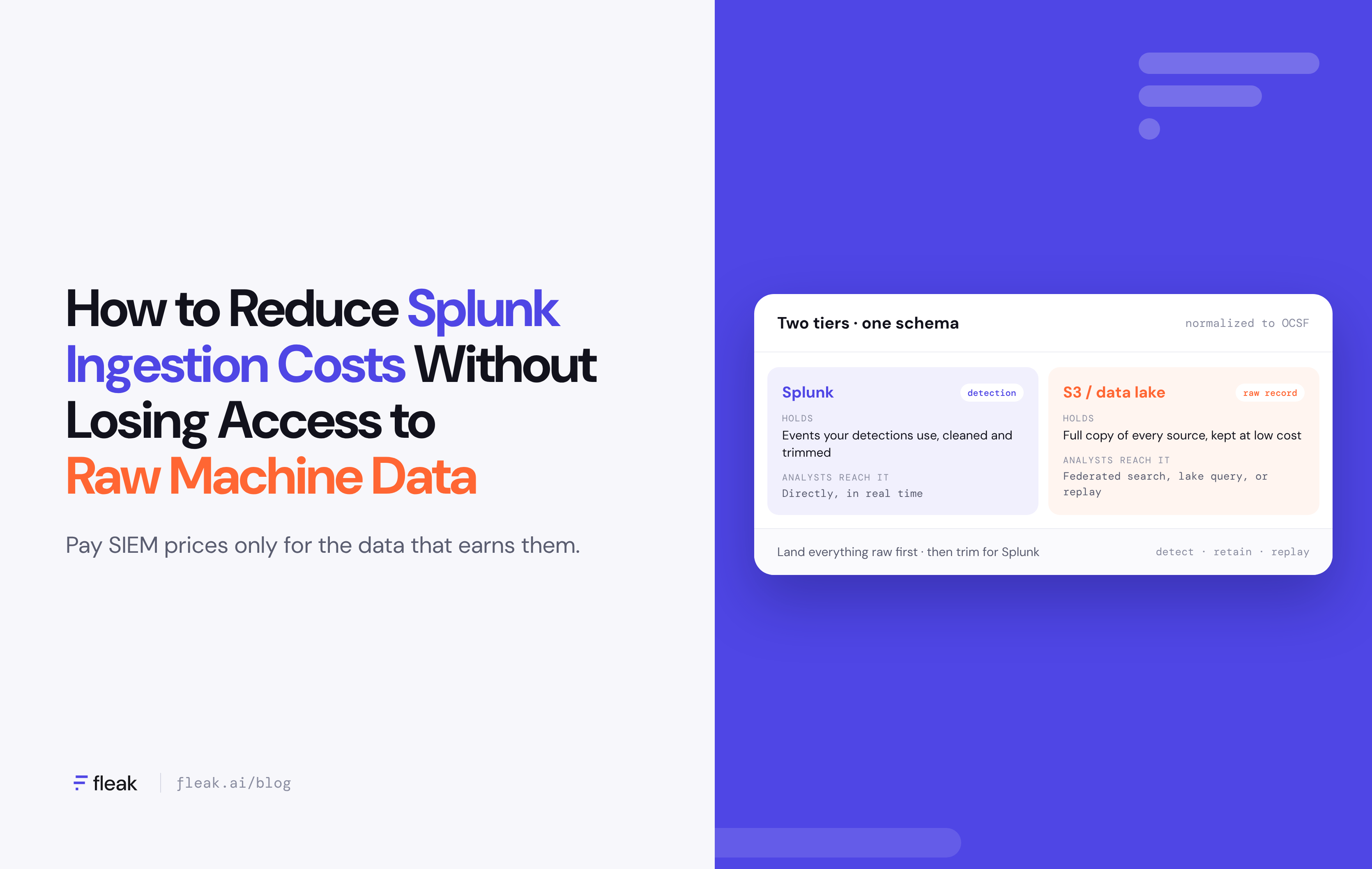
The short answer: Stop treating Splunk as the place where all raw data has to live. Keep the full, raw record in low-cost storage you control, and send Splunk only the events your detections and dashboards use, cleaned and trimmed. That's the core of SIEM cost reduction: you pay SIEM prices for the data that earns them, and you can still reach everything else when an investigation needs it.
Most security leaders have had some version of this conversation: the Splunk renewal is up, data volumes grew faster than the budget, and someone suggests cutting sources. The pushback is immediate, and reasonable. Raw machine data is what you fall back on during an incident, an audit, or a threat hunt. Nobody wants to explain after a breach that the logs were turned off to save money.
That framing assumes you have only two choices: keep everything in Splunk, or lose it. You don't. The data can live in more than one place, and only part of it needs to sit in your most expensive tool.
In this post, we'll cover why Splunk ingestion costs keep climbing, what Splunk itself offers to manage them, and what a SIEM cost reduction strategy looks like when keeping access to raw data is non-negotiable.
Why Splunk ingestion costs keep climbing
Splunk offers both ingest-based and workload-based pricing. Under ingest pricing, cost tracks the daily volume of data you send. Under workload pricing, cost tracks the compute your searches use, and large data volumes still drive it, because more data means more indexing and more to search. Either way, the more raw data you push into Splunk, the more you pay.
And the volume keeps growing, for a few reasons:
- More sources. Cloud audit logs, SaaS apps, identity providers, endpoint agents, and now AI agents all produce telemetry security teams want to see.
- Verbose formats. Firewall, network flow, and cloud logs carry many fields per event, and most searches read only a few of them.
- Duplicates and noise. Health checks, heartbeats, repeated events, and empty records are indexed at the same price as real signal.
- Retention requirements. Compliance and investigation needs push teams to keep more data, for longer.
The part that makes this hard is that the expensive data and the important data aren't the same thing. A small share of events feeds most detections. A much larger share is raw context that matters only occasionally, during an investigation or audit. But it matters a lot when it does, which is why cutting it feels so risky.
What Splunk offers, and where it stops
Splunk has added several ways to manage cost, and they're worth knowing. Each solves part of the problem.
|
Option |
What it does |
The limitation |
|---|---|---|
|
Switching pricing models |
Moves cost from data volume to search compute |
Can help some workloads, but large volumes still cost money to index and search |
|
Ingest actions and Edge Processor |
Filter, mask, or route events before indexing |
Rules are built around Splunk. Managing them across many sources and other destinations gets complex |
|
Shorter retention plus archiving |
Keeps older data in cheaper archive storage |
Archived data usually has to be restored before you can search it, which slows investigations |
|
Federated Search for Amazon S3 |
Searches datasets in your own S3 buckets from Splunk |
Works best when data in S3 is already clean and structured (JSON, CSV, Parquet); AWS regions only |
The last one is important, because it changes the question. If Splunk can search data that lives in your S3 buckets, then not every raw event has to be indexed for you to keep access to it. What's left is making sure the data in S3 is complete, consistently formatted, and organized well enough to search. That's a data pipeline problem, not a SIEM problem.
What a SIEM cost reduction strategy looks like
Reducing Splunk ingestion costs without losing access to raw data comes down to a few decisions. Your engineers will handle the implementation, but these choices set the outcome.
- Land everything in storage you own first. Send the full, raw record from every source to S3 or a data lake before anything is filtered. That copy is your safety net for investigations, audits, and threat hunting, and it's far cheaper than SIEM storage.
- Start from your detections, not your data. Ask which Splunk searches, correlation rules, and dashboards each source feeds. That defines what Splunk actually needs.
- Filter and trim before Splunk. Drop duplicates, empty records, and routine noise. Remove fields no search reads. Send Splunk the events that remain.
- Normalize everything to one schema. Mapping data to a common schema like OCSF makes the raw copy searchable, through federated search or a lake engine, and lets you correlate across sources. It's also what makes the data ready for AI-assisted detection and investigation.
- Make the raw tier easy to reach. Agree on how analysts get to data that isn't in Splunk: federated search, a lake query engine, or replaying a time window into Splunk on demand.
- Measure and revisit. Track volume and cost per source and destination, and review the rules as detections change.
This is the problem we built Fleak to solve. Fleak sits in front of your SIEM, not in place of it. It collects data from your sources, normalizes it to OCSF, UDM, or a custom schema, and routes each record to the right place: Splunk for real-time detection, your data lake for hunting and investigation, and an archive for compliance. Because the copy in your lake is already clean and consistently structured, it's ready to search when you need it.
Your team describes the rules in plain English, and Fleak's copilot builds the pipeline. AI writes the config, but a deterministic engine runs it, so production data never passes through an AI model. When a source format changes, Fleak detects the drift and redeploys a corrected config, with an average time to heal of about three minutes.
How the two tiers work together
The result is a two-tier setup. Splunk holds the smaller, high-value set of events that powers real-time detection. Your lake holds the complete raw record, normalized and ready to search. When an investigation needs more, analysts reach into the lake instead of wishing the data had been kept.
|
Tier |
What it holds |
How analysts reach it |
|---|---|---|
|
Splunk (detection) |
Events your detections use, cleaned and trimmed |
Directly, in real time |
|
Data lake or S3 (raw record) |
Full copy of every source, normalized to OCSF, kept at low cost |
Federated search, a lake query engine, or replay into Splunk |
A few practices keep this working over time:
- Detection-first routing. If no detection or dashboard reads a type of event, it doesn't need to be indexed in Splunk.
- One schema across both tiers. When the data in Splunk and the data in the lake share a schema, a search or detection written for one works on the other.
- Summaries for high-volume sources. Hourly rollups of routine activity keep trends visible in Splunk without the full volume.
- Rehydrate on demand. When an investigation needs raw events, replay only that time window and those hosts into Splunk.
For security leaders, the practical result is a SIEM budget that tracks detection value instead of raw data volume, with no loss of access to the data itself.
Questions to ask your team
- Which sources make up most of our Splunk ingest, and which detections use them?
- If we stopped indexing a source tomorrow, where would the raw data still exist?
- How long does it take an analyst to reach data that isn't in Splunk today?
- Is our data normalized well enough to search outside Splunk, or to feed AI-assisted tools?
- How much engineering time goes into maintaining parsers and ingestion pipelines?
FAQ
What is SIEM cost reduction?
SIEM cost reduction is the practice of lowering what you spend on your SIEM without weakening detection or investigation. In practice, it usually means sending the SIEM less data, cleaner data, or both, and keeping the rest in cheaper storage.
How do we reduce Splunk ingestion costs without losing access to raw machine data?
Keep a full, normalized copy of raw data in storage you control, such as S3 or a data lake. Send Splunk only the events your detections and dashboards use. Analysts can still reach the raw copy through federated search, a lake query engine, or by replaying a time window into Splunk.
Won't searching data outside Splunk slow down investigations?
It can, if the data is messy or archived in a format that needs restoring first. That's why normalization matters. When the raw copy is clean and consistently structured, it's ready to query the moment an investigation needs it.
How much can this reduce Splunk ingest?
It depends on your sources and detections. Teams using Fleak typically cut SIEM ingest by 60–80%.
Does Fleak replace Splunk?
No. Fleak sits in front of Splunk and controls what it receives. Your searches, dashboards, and detections stay where they are; they just run on cleaner, smaller data.
Can Fleak run in our own environment?
Yes. Fleak runs as managed SaaS, in your own cloud, on-premises, or air-gapped, and it doesn't store customer data.
Get started
Most Splunk bills are driven by a handful of noisy sources. A log volume cost audit shows you which ones, how much of that data your detections actually use, and what you could route to cheaper storage without losing access to it. Request an audit and we’ll walk through the results with your team.
Sources
- Overview of Federated Search for Amazon S3, Splunk documentation
- Splunk Enterprise and Splunk Cloud Platform pricing FAQ, Splunk