The short answer
To reduce Cisco firewall logs sent to Splunk, treat log reduction as a data strategy rather than a cleanup project. Suppress what's never useful at the firewall, filter and summarize the rest in a security data pipeline before it reaches Splunk, and keep a low-cost archive of everything for compliance. Done well, you lower SIEM spend without lowering visibility.
For most security leaders, the real question isn't whether you can cut firewall data. It's how to do it without creating a blind spot you'll have to explain later.
Why firewall log volume is a budget problem
Firewalls are often the single largest data source in a SIEM. Cisco ASA and Firepower Threat Defense (FTD) devices log at the connection level, so every session on your network can produce two or more events: one when the connection opens and one when it closes. On a busy perimeter, that's millions of events an hour.
Splunk is typically priced on how much data you ingest or how much compute you use to search it. Either way, firewall volume grows with your business, not with your risk. More users, more cloud traffic and more branch offices all push the bill up, even when nothing more dangerous is happening.
That creates a familiar pattern for security leaders:
- Costs rise faster than budgets. Each license renewal brings a harder conversation with the CFO about why security data spend keeps climbing.
- Teams start cutting blindly. Under pressure, engineers drop whole data sources or shorten retention, often without a clear view of what detections depend on them.
- Analysts drown in noise. A large share of firewall events are routine, permitted traffic nobody investigates. That noise slows searches and makes real threats harder to spot.
Log reduction breaks that pattern by letting you decide, deliberately, which data earns a place in your most expensive platform.
Less data, not less security
The biggest concern executives raise about log reduction is risk. If you send less to Splunk, will you miss an attack, fail an audit or lose evidence during an incident?
It's a fair concern, and the answer depends on how the reduction is done. Not all firewall data carries the same value:
- Redundant events add cost but no information. A connection "opened" event is largely repeated in the matching "closed" event, which also records duration and bytes transferred.
- Routine, trusted traffic like internal DNS, time sync and backups rarely changes an investigation's outcome.
- High-value events like denied connections from outside, VPN logins and administrator activity are exactly what your detections and auditors need.
A sound strategy keeps the third group in Splunk, summarizes or archives the second, and drops the first. It also keeps a full-fidelity copy of everything in low-cost storage, so nothing is truly lost if an investigator or regulator needs it later.
In other words, log reduction done right is a governance decision about where data lives, not a decision to stop collecting it.
A three-layer log reduction strategy
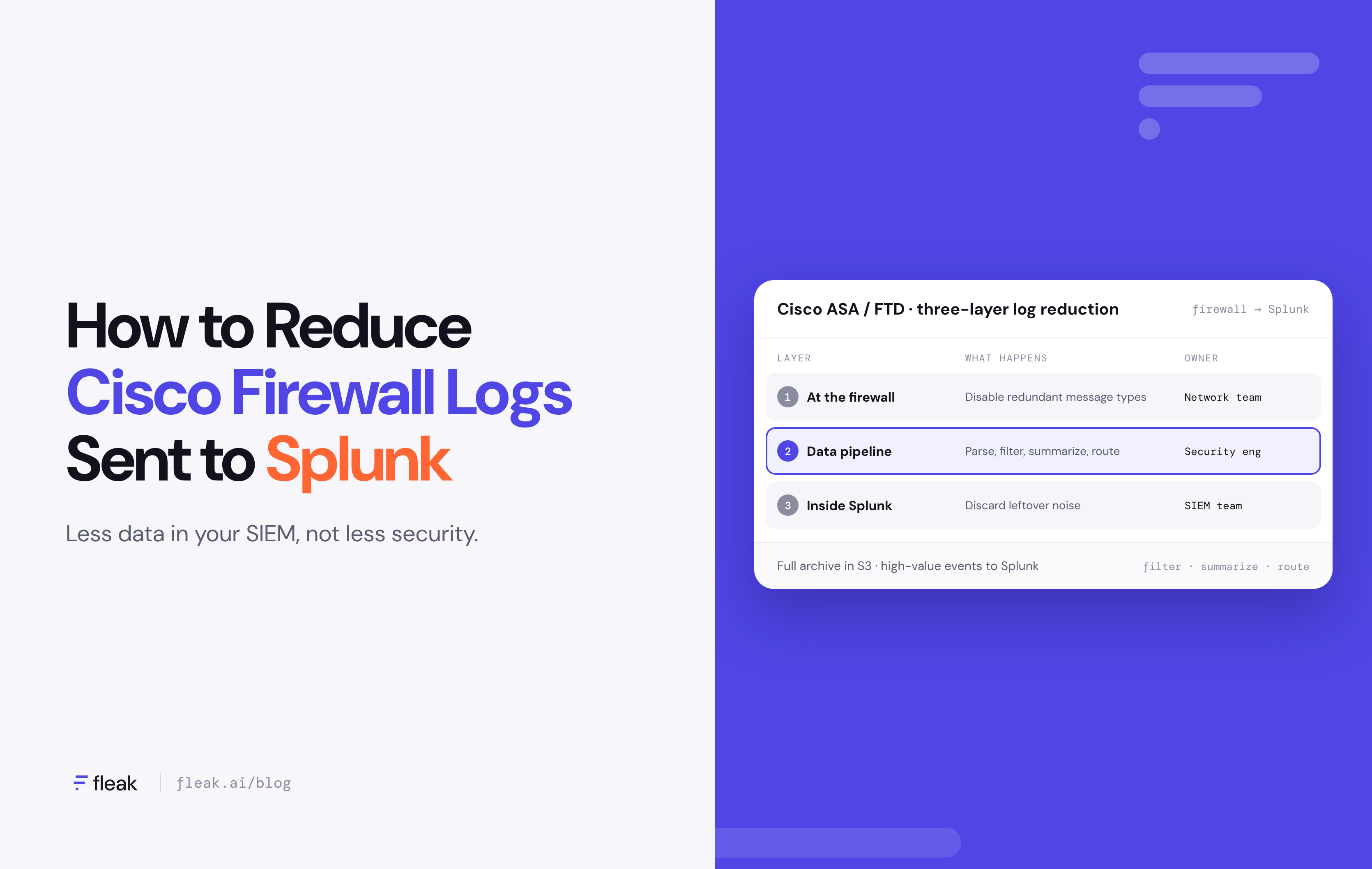
The most effective programs reduce Cisco firewall logs in three places, each with a different owner and tradeoff.
|
Layer |
What happens there |
Typical owner |
Strength |
Limitation |
|---|---|---|---|---|
|
1. At the firewall |
Turn off message types you never need, such as redundant connection-opened events |
Network team |
Cheapest: data is never sent |
All-or-nothing, needs a change on every device, can't be undone after the fact |
|
2. In a security data pipeline |
Parse, filter, summarize and route events before Splunk, based on what's inside them |
Security engineering or data team |
Biggest savings with the most control; can archive everything cheaply |
Needs a pipeline platform and clear rules |
|
3. Inside Splunk |
Discard leftover noise before it's indexed |
SIEM team |
Familiar tooling, good safety net |
Rules are hard to maintain at scale and can only keep or drop |
Most of the value sits in the middle layer. That's where your team can make nuanced calls, like keeping a connection event when it involves an external IP or a sensitive server but dropping it for internal-to-internal traffic. It's also where you can route full-fidelity data to inexpensive storage like Amazon S3, so compliance and incident response never depend on what you chose to keep in Splunk.
Questions to ask your security team
You don't need to know Cisco message IDs to lead a log reduction effort. You do need clear answers to a few questions:
- What share of our Splunk ingest comes from firewalls, and which event types drive it? If no one can answer quickly, visibility into your own data is the first gap to close.
- Which detections and reports depend on firewall data? Every reduction rule should map back to this list, so nothing critical is cut by accident.
- Where does the data we don't send to Splunk go? "Nowhere" is the wrong answer. A low-cost archive protects compliance and investigations.
- Who approves a new reduction rule, and how is it tested? Treat reduction rules like detection rules: reviewed, documented and monitored.
- How will we know if a firewall goes quiet? A sudden drop in volume could be a rule working too well, or a device that stopped logging for a less benign reason.
And a few metrics worth tracking each quarter:
- Firewall data sent to Splunk per day, before and after reduction
- SIEM cost per gigabyte, or per business unit
- Detection coverage for firewall-based use cases
- Mean time to investigate firewall-related alerts
Where Fleak fits
Every smart reduction decision depends on one thing: knowing what's inside each event. Raw Cisco syslog is semi-structured text, and you can't reliably filter, summarize or route data you haven't parsed. That's why log reduction really starts with getting your data foundation right.
Fleak provides that foundation between your firewalls and Splunk:
- Structured data from day one. Fleak's AI mapping agent generates parsers from a few sample events, so onboarding a Cisco source doesn't wait on weeks of hand-written regex.
- A common schema across tools. Fleak normalizes firewall logs into the Open Cybersecurity Schema Framework (OCSF), an open standard, so firewall data lines up with identity, endpoint and cloud telemetry. That makes cross-source correlation possible and reduces lock-in to any one SIEM.
- Reduction your team controls. With data structured in-stream, your engineers can write clear, reviewable rules on named fields to filter, summarize and route events before they reach Splunk.
- Fits your existing Splunk investment. The Fleak OCSF Mapper app on Splunkbase works with Splunk Enterprise and Splunk Cloud, so teams can start where they are.
There's a strategic angle here too. Many security organizations are planning to put AI-assisted triage or agents on top of their SIEM. Those tools are only as good as the telemetry they're given. Clean, normalized, well-labeled data is what makes AI in the SOC useful rather than just expensive.
Frequently asked questions
What is log reduction?
Log reduction is the practice of cutting the volume of log data sent to a SIEM without losing the events that matter for security, compliance or troubleshooting. It typically combines filtering, summarizing, deduplicating and routing data to lower-cost storage.
How do you reduce Cisco firewall logs sent to Splunk?
Use three layers. Disable redundant message types on the firewall, filter and summarize events in a security data pipeline before Splunk, and discard leftover noise inside Splunk before indexing. Keep a full-fidelity archive in low-cost storage for compliance and investigations.
Will log reduction weaken our security posture?
Not if it's governed. Map every reduction rule to the detections it could affect, keep an archive of all raw data, and monitor for unexpected drops in volume. The goal is to move low-value data to cheaper storage, not to stop collecting it.
Does reducing logs affect compliance?
It can if data is deleted outright. Routing full-fidelity logs to an archive such as Amazon S3 lets you meet retention requirements while sending only high-value events to Splunk.
Is log reduction a one-time project?
No. Traffic patterns, devices and detections change. The most effective teams review reduction rules on a regular cadence, the same way they review detection content.
How does Fleak help with log reduction?
Fleak parses and normalizes Cisco firewall logs into OCSF before they reach Splunk, using AI-generated mappings. Structured data lets your team filter, summarize and route events with clear rules, and leaves the data that does reach Splunk ready for correlation and AI-assisted analysis.
Bottom line
Cisco firewall data will keep growing with your business. Paying to index every routine connection in Splunk isn't a sustainable plan, but cutting data without a strategy creates risk you'll eventually have to answer for.
The security leaders who get log reduction right treat it as a data governance decision. They decide what belongs in the SIEM, what belongs in an archive, and what doesn't need to be kept at all. Then they build on structured, normalized data so every one of those decisions is easier to make and easier to defend.
If you’re looking at how to reduce Cisco firewall logs sent to Splunk, get a log volume cost audit to find out how much you could cut without losing visibility.