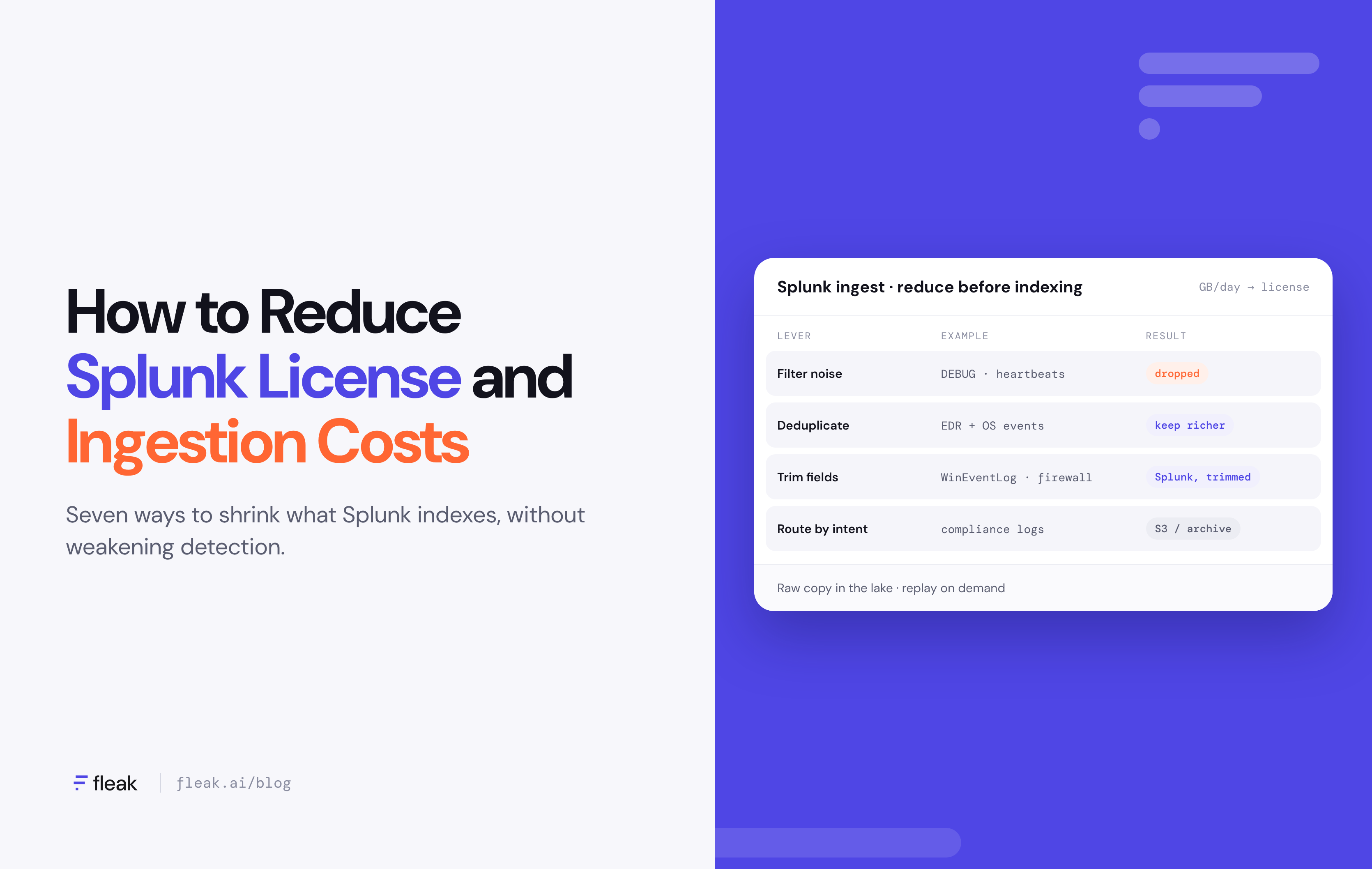
SIEM cost reduction starts with what you send to your SIEM, not with what you pay for it. Most Splunk bills scale with data volume, and a large share of that volume never feeds a detection. This guide covers what drives Splunk license and ingestion costs, and the practical ways security teams bring them down.
How do you reduce Splunk license and ingestion costs?
To reduce Splunk license and ingestion costs, shrink the data before it is indexed. Filter out noise, remove duplicates, trim verbose fields, and route low-value logs to cheaper storage instead of Splunk. A security data pipeline like Fleak does this in stream, so Splunk only indexes the data your detections and investigations actually use.
What drives Splunk license and ingestion costs?
Splunk offers two main pricing models. Ingest pricing charges for the volume of data you index per day, measured in GB/day. Workload pricing charges for the compute capacity your searches and indexing consume (Splunk Lantern). Under either model, more data means a bigger bill: more to index, more to store, and more for every search to scan.
In most environments, four things push volume up faster than the security value it brings:
- Verbose log formats. Windows Security events, firewall traffic logs, and cloud audit trails carry long static text and fields no detection ever reads.
- Duplicate data. The same activity is often logged by several tools, such as an EDR agent and the operating system, or a proxy and a firewall.
- Operational noise. DEBUG logs, heartbeats, and successful health checks add steady volume and rarely trigger an alert.
- Retention in the wrong tier. Data kept for compliance or occasional forensics sits in hot, indexed storage, the most expensive place to keep it.
Add new sources every quarter, and SIEM costs grow even when headcount and detection coverage stay flat.
Where SIEM cost reduction actually comes from
The biggest savings come from reducing volume before indexing, not from tuning searches after they’ve reached the SIEM. Each lever below removes a different kind of waste, and a raw copy in cheap storage means none of it is gone for good.
Only detection data reaches the Splunk index. Everything else stays in the lake, where it can be searched or replayed into Splunk on demand.
7 ways to reduce Splunk license and ingestion costs
- Measure indexed vs. used data. Break down daily license usage by sourcetype, then map which sourcetypes your correlation searches, dashboards, and saved searches reference. Sourcetypes with high volume and no detection use are your first targets.
- Filter noise before indexing. Drop DEBUG logs, heartbeats, successful health checks, and known-benign events in the pipeline, before they count against your license.
- Deduplicate across sources. When two tools report the same event, keep the richer one for the SIEM. This is often an easy win in EDR and network data.
- Trim and reshape verbose events. Remove static message text and unused fields. Windows and firewall logs in particular can often be cut substantially without losing any field a detection needs.
- Normalize to a common schema. Mapping events to a standard such as OCSF (Open Cybersecurity Schema Framework) produces smaller, consistent records and makes cross-source correlation easier.
- Route by intent. Send real-time detection data to Splunk, threat-hunting data to a data lake such as Amazon S3, and compliance logs to low-cost archive storage. Data you rarely query does not need to live in an index.
- Convert high-volume logs to metrics where it fits. For performance and health data, a count or rate per minute often answers the question that thousands of raw events used to.
Start with measurement, since it tells you where the savings are. And before you turn on any filter, keep a raw copy in cheap storage. That one step makes the rest low-risk, because nothing you drop from Splunk is gone for good.
Native Splunk tools vs. a security data pipeline
Splunk has its own options for reducing ingest. Ingest Actions filters, masks, and routes data to Splunk or S3. Edge Processor and Ingest Processor run SPL2 pipelines that filter, transform, and route data. They are a reasonable starting point, especially if Splunk is your only destination. Splunk Cloud customers also have Machine Data Lake, a lower-cost retention tier where full-fidelity data stays in object storage and only selected slices are promoted into an index. It is a useful destination for data you keep but rarely search, but it’s important to note that it does not deduplicate, normalize, or route data outside Splunk.
|
|
Native Splunk tools |
Security data pipeline (Fleak) |
|---|---|---|
|
Destinations |
Splunk, Amazon S3 (plus Observability Cloud for Ingest Processor) |
Splunk plus lakes and warehouses such as S3, Databricks, Snowflake, BigQuery, and other SIEMs |
|
Deduplication |
Not yet supported in Edge Processor |
Built in |
|
Schema normalization |
Hand-written SPL2 |
OCSF, UDM, or custom schema mapping |
|
Schema drift |
Manual fixes when a source format changes |
Detected and repaired automatically, with optional review |
|
Pipeline authoring |
SPL2 or config files |
Plain-English copilot generates the config |
|
Vendor lock-in |
Tied to Splunk |
SIEM-agnostic, which also eases a future SIEM migration |
The native tools work well for a few simple rules. Teams with many sources, several destinations, or frequent format changes usually need a dedicated pipeline layer.
How Fleak helps with SIEM cost reduction
Fleak is a security data pipeline that sits in front of Splunk, not in place of it. It connects to your sources, reduces and normalizes the data in stream, and sends each event where it belongs. Your detections, dashboards, and SPL stay as they are.
What that means for your Splunk bill:
- Less data indexed. Filtering, deduplication, and field trimming happen before data reaches Splunk.
- Nothing lost. A full raw copy goes to your data lake, so hunting, forensics, and compliance still have every event. When an investigation needs it, Fleak can replay a time window back into Splunk.
- No silent breakage. When a vendor changes its log format, Fleak detects the schema drift and repairs the pipeline config, so detections do not quietly stop firing.
- Less engineering time. Describe a pipeline in plain English, such as "send Okta failed logins to Splunk and everything else from Okta to S3," and Fleak's copilot writes the configuration for you to review. Fleak reports that time to onboard a new source drops from months to about a week.
AI writes the config, but execution is deterministic and production data never passes through an AI model. Fleak runs as managed SaaS, in your own cloud, on-premises, or air-gapped, and does not store customer data.
SIEM cost reduction FAQ
What is SIEM cost reduction?
SIEM cost reduction is the practice of lowering what you spend on a SIEM such as Splunk without weakening threat detection. Since most SIEM pricing scales with data volume or compute, it usually means reducing and rerouting the data that reaches the SIEM.
Why is Splunk so expensive?
Splunk costs scale with how much data you index per day (ingest pricing) or how much compute you use (workload pricing). Machine data grows quickly, and much of it is verbose, duplicated, or rarely searched, so bills rise faster than the security value they bring.
Can I reduce Splunk costs without losing data?
Yes. Keep a full raw copy in low-cost object storage such as Amazon S3, and send only detection-relevant data to Splunk. You can still search the lake or replay data into Splunk when you need it.
What data should I stop sending to Splunk?
Good candidates are DEBUG logs, heartbeats, successful health checks, duplicate events, and unused fields in verbose formats. Check each filter against your detection rules before it goes live.
Does Splunk Machine Data Lake reduce Splunk costs?
It can. Machine Data Lake keeps full-fidelity data in lower-cost object storage and lets you promote only what you need into a Splunk index. It is available in select Splunk Cloud regions. It works best alongside a pipeline that filters, deduplicates, and normalizes data before it lands, which is where a tool like Fleak fits.
Is Splunk Ingest Actions or Edge Processor enough?
For a handful of simple filter rules with Splunk as the only destination, often yes. Teams with many sources, multiple destinations, deduplication needs, or frequent schema changes usually add a dedicated security data pipeline.
How much can a security data pipeline save on SIEM costs?
It depends on your source mix. Fleak reports typical SIEM ingest reductions of 60 to 80 percent. Auditing your indexed vs. used data by sourcetype gives you a realistic estimate for your own environment.
Start cutting your SIEM costs
The most effective SIEM cost reduction does not come from negotiating a better contract. It comes from sending your SIEM only the data it needs and keeping the rest somewhere cheaper. Splunk stays focused on detection, your raw data stays accessible, and the bill reflects the security value you get from it.
If you want to see how much of your Splunk volume you could cut, get a log volume cost audit. Most teams start with their noisiest source.
See how much of your Splunk volume you could cut
Get a log volume cost audit for your environment. Most teams start with their noisiest source.