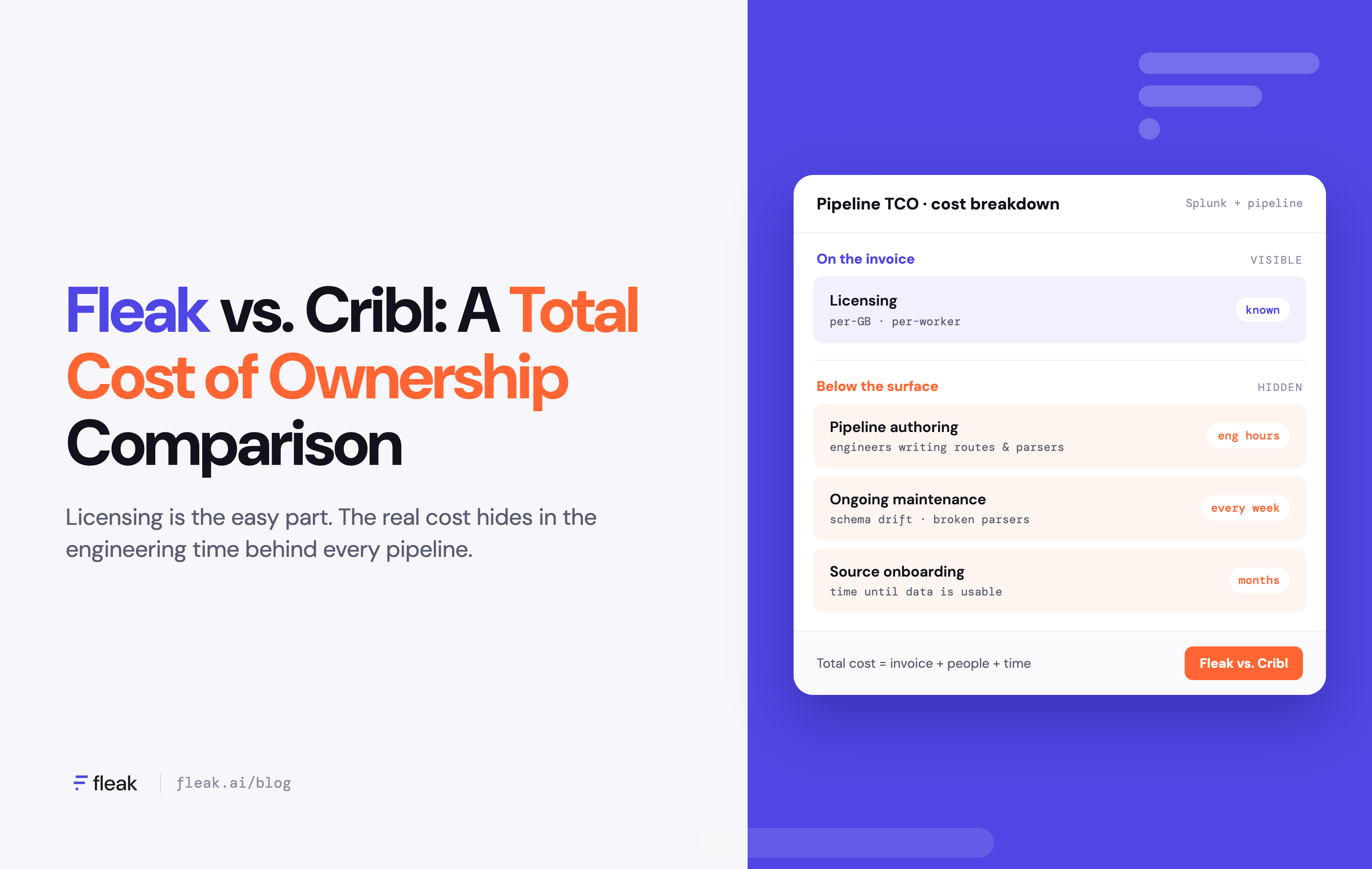
If your security team runs Splunk and Cribl, you already know the invoices. Determining licensing costs is the easy part. Other costs associated with data pipelines are less visible: the engineers who author and maintain pipelines, the months it takes to bring a new source online, and the bill that grows when your data volume does.
This article walks through the total cost of ownership (TCO) of a pre-destination pipeline layer, and where Fleak and Cribl differ on each part. Cribl is no doubt a capable product with strong routing and reduction features, and many teams run it well. The question is what it costs to run, and who has to run it.
Fleak vs. Cribl: What Are They?
Both Cribl and Fleak are tools for moving and processing data between sources and destinations. They sit in the pipeline layer in front of SIEMs, observability platforms, and data lakes, shaping and routing telemetry before it lands. Where they differ is who does the work and how.
Cribl is a vendor of data engine products designed for IT and security telemetry. Its core product suite lets organizations route, reduce, enrich, and replay logs, metrics, and traces to destinations such as SIEMs, observability platforms, and data lakes. Cribl is typically licensed by data volume or compute usage, and operating it well generally requires dedicated administrators or data engineers who can author and maintain pipeline logic. It is a strong fit for organizations with the headcount and expertise to make full use of that control.
Fleak is a low-code, API-driven, AI-enabled data pipeline platform built for constructing and running data workflows with minimal infrastructure and engineering overhead. It allows teams to connect sources, normalize data, and route it to destinations without writing and maintaining pipeline code by hand. The platform is designed for teams that need to move quickly or operate without dedicated pipeline specialists.
What You Are Actually Buying
Splunk is the destination. It is where data lands and gets searched. Neither Fleak nor Cribl replace it. Rather they both sit in front of it, cleaning, normalizing, and routing machine data before ingestion.
That layer is where cost builds up, so TCO should be measured there. A fair comparison covers five categories:
- Licensing and pricing model
- Integration and onboarding cost
- Ongoing engineering and operations
- Downstream destination cost (SIEM ingest and storage)
- Risk and change cost (migrations, outages, broken pipelines)
1. Licensing and Pricing Model
The shape of the pricing model matters as much as the number on the quote.
Fleak is priced per source or per endpoint, not per data volume. Cost stays predictable when telemetry cardinality grows or an incident produces a spike in logs. Finance teams can forecast it from the number of sources, which changes slowly, rather than from gigabytes, which do not.
Volume based pricing, by contrast, tends to rise at the moments you least want it to: during incidents, after an acquisition, or when a new application ships verbose logs. When you model TCO, run both a baseline year and a high volume year. A model that is flat in the second case is worth real money.
2. Integration and Onboarding Cost
This is where the two approaches differ most.
Cribl is an authored-pipeline product. An SRE or data engineer builds each pipeline by hand in the Cribl UI or in SPL2. That gives fine-grained control, and it assumes you have the headcount and pipeline expertise to use it. Every new log source means parsing, field mapping, routing rules, and testing.
Fleak is a generated-pipeline product. Its AI-assisted layer generates pipeline configuration from the source schema, including normalization and routing. Based on Fleak's own figures:
- New sources onboard in about 3 minutes, compared with roughly 6 months for a deep pipeline engineering effort on the authored model
- Integration cost is about 90% lower
- The same team covers roughly 10 times more devices
These are Fleak's figures, and your results will depend on your source mix. They are best treated as a hypothesis to test in a proof of value on your own sources. Still, if your team maintains 200 or more pipelines by hand, the engineering time behind those pipelines belongs in the TCO model.
3. Ongoing Engineering and Operations
Licensing is a visible line item. Engineering time usually is not, even though it often costs more.
With an authored model, every schema change, new vendor format, or broken parser becomes a ticket for someone who understands the pipeline internals. Those people are scarce and expensive, and they are also the people you would like working on detection and response.
Fleak adds self-healing to normalization and routing, so common breakages are handled by the platform instead of the on-call engineer. Every AI action is inspectable and gated behind human approval, so the team keeps control without doing the repetitive work.
When you build your model, count:
- Engineer hours per new source onboarded
- Engineer hours per month spent on pipeline maintenance and fixes
- The loaded cost of those hours
- The backlog of sources you have not onboarded because there is no capacity
That last item is easy to miss. Unverified sources are a coverage gap․ Coverage gaps are cost risks․
4. Downstream Destination Cost
The pipeline layer also controls what you pay your SIEM. Per-GB SIEM pricing makes every unnecessary event expensive.
Fleak filters and shapes data at the source, routes detection-critical events to the SIEM, and sends the remaining data to a lower cost security lake or object store. Full retention is preserved, and the SIEM only ingests what it needs for detection. Because Fleak is destination agnostic, you can change where data goes without rebuilding the pipeline.
Cribl also offers routing and reduction. The difference to evaluate is how much of that reduction logic your team must design, test, and keep current by hand, versus how much is generated and maintained for you.
5. Risk and Change Cost
Two costs show up less often in spreadsheets.
Migration cost. SIEM and lake migrations are expensive partly because you cannot verify parity until you cut over. Fleak supports dual-write pipelines that deliver the same normalized data to old and new destinations, so you can confirm signal parity before switching.
Switching cost from an existing Cribl deployment. Teams reasonably worry that replacing a pipeline layer means rebuilding it. Fleak's migration from Cribl is AI assisted, so the work of re-creating existing pipelines is not left to your team. Fleak and Cribl can also run side by side, which lets you move source by source instead of all at once.
A Side by Side Summary
|
TCO category |
Cribl |
Fleak |
|
Pipeline model |
Authored by hand by an SRE or data engineer |
Generated from source schema by AI, with human approval |
|
Pricing basis |
Evaluate against your own contract |
Per source or per endpoint, not per data volume |
|
New source onboarding |
Engineering effort per source |
About 3 minutes per source (Fleak figure) |
|
Engineering coverage |
Scales with headcount |
About 10x more devices with the same team (Fleak figure) |
|
Integration cost |
Depends on team and source count |
About 90% lower (Fleak figure) |
|
Destinations |
Multiple |
Destination agnostic, with dual-write for migrations |
|
Best fit |
Teams with data engineering headcount who want fine-grained control |
Teams that need pipelines faster than they can hire engineers to author them |
How to Build Your Own TCO Model
Use this sequence with your finance and security engineering leads:
- List your current spend. Splunk ingest and license, Cribl license, and any related infrastructure.
- Count sources and pipelines. How many log types do you maintain pipelines for today, and how many are waiting to be onboarded?
- Estimate engineering time. Hours per new source and hours per month on maintenance, at loaded cost.
- Model two volume scenarios. A baseline year and a year with a major incident or growth event.
- Add downstream savings. What share of events needs to reach the SIEM, and what could go to cheaper storage?
- Price the risk. Include the cost of coverage gaps and a migration with no way to check parity.
Teams spending over $300K a year on Splunk and Cribl combined, with a security operations budget above $2M, tend to find the engineering and volume lines larger than expected.
When to Choose Cribl vs. When to Choose Fleak
Choose Cribl When
- You need a mature, broad telemetry pipeline capable of handling large-scale logs, metrics, and traces across complex environments.
- Your primary goal is routing, filtering, and reducing data volumes headed to SIEM and observability tools.
- You can staff dedicated pipeline administrators to manage and maintain the platform.
- You rely on Cribl's ecosystem of packs, integrations, and capabilities such as Replay and Search.
- Your organization has already standardized on Cribl and is expanding an existing deployment.
Choose Fleak When
- You want low-code pipelines that can be built and modified quickly without deep engineering effort.
- You have a small team without dedicated pipeline specialists and need something your existing staff can own.
- You want to minimize infrastructure footprint and ongoing operational overhead.
- Your workflows are API-driven or require AI-enabled processing as a first-class capability.
- Predictable total cost of ownership matters more to your organization than a broad feature surface.
Get a Number for Your Environment
A general comparison only goes so far. The useful answer is the one built from your sources, your volumes, and your contracts. Calculate your savings with the Fleak cost reduction analysis, or book thirty minutes with the Fleak team to walk through your sources. No system access is required.
Ready to choose Fleak?
Book a 30 minute demo to start