
The First Mile Gap: Why Your Autonomous Systems Know Everything but Understand Nothing
We are currently seeing a massive disconnect in corporate technology. While 2025 is being called the "Year of the Agent," about 90% of these autonomous projects fail within their first month. Every leader is under pressure to show results, but most are finding that their systems are built on a foundation that simply cannot handle the load.
The industry is currently focused on the Model Context Protocol (MCP). This is a helpful standard for how different software tools talk to one another—think of it as a universal plug for your data. However, a universal plug does not guarantee that the information flowing through it is accurate. Connecting an autonomous system to dozens of raw data sources without a clear translation layer just creates a larger room for error and confusion.
To win this race, we need to move away from the "System of Record" and toward a "System of Context."
The Manual Mapping Trap: A Financial and Operational Anchor
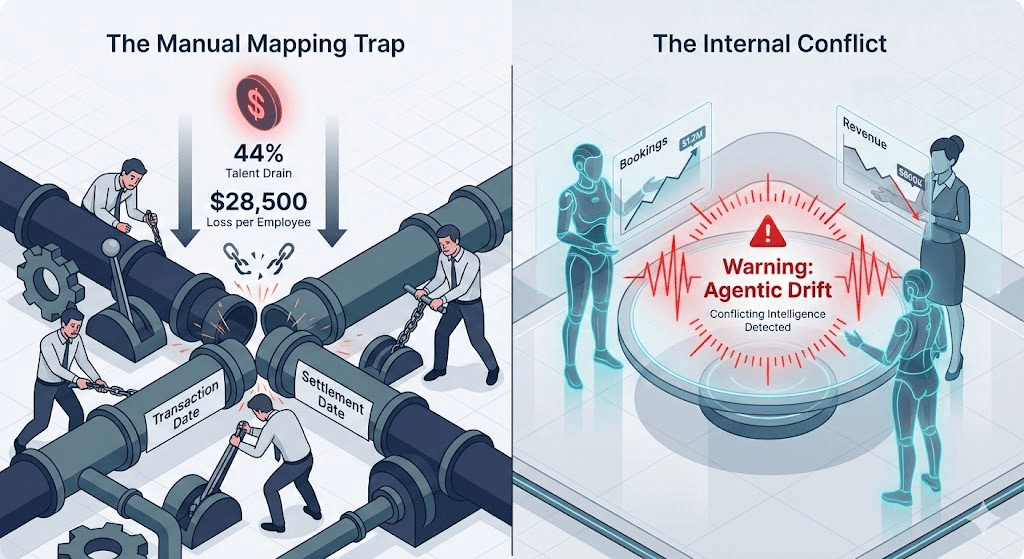
Most companies are still stuck in the era of manual data engineering. Your teams likely spend 44% of their time building and fixing data pipelines. This is effectively "high-IQ waste management." It costs U.S. companies an average of $28,500 per employee annually in lost productivity.
When you rely on manual rules, you run into a Meaning Mismatch. 8 In a global company, data is messy. A "transaction date" in a European system might mean something entirely different than a "settlement date" in a U.S. system. When an autonomous system sees these differences, it simply cannot be relied on to “guess” correctly. In fact, research shows these systems only finish their tasks about 55% of the time when working with real-world, noisy data.
When Systems Disagree: The "Internal Conflict" Risk
In 2025, the worry was a single assistant making a mistake. In 2026, the risk is a conflict between multiple systems. If your Sales system sees "Bookings" and your Finance system sees "Revenue," and they haven't been harmonized, they will make conflicting decisions.
Trying to fix this by "stuffing" every database rule into the system's memory also fails. Most models lose their focus and reasoning ability by 50% once they are forced to track too much information at once. A better foundation handles this translation before the system ever sees the data.
Evidence from the Field: Real Impact
Companies moving to automated data translation are pulling ahead of those stuck in manual workflows:
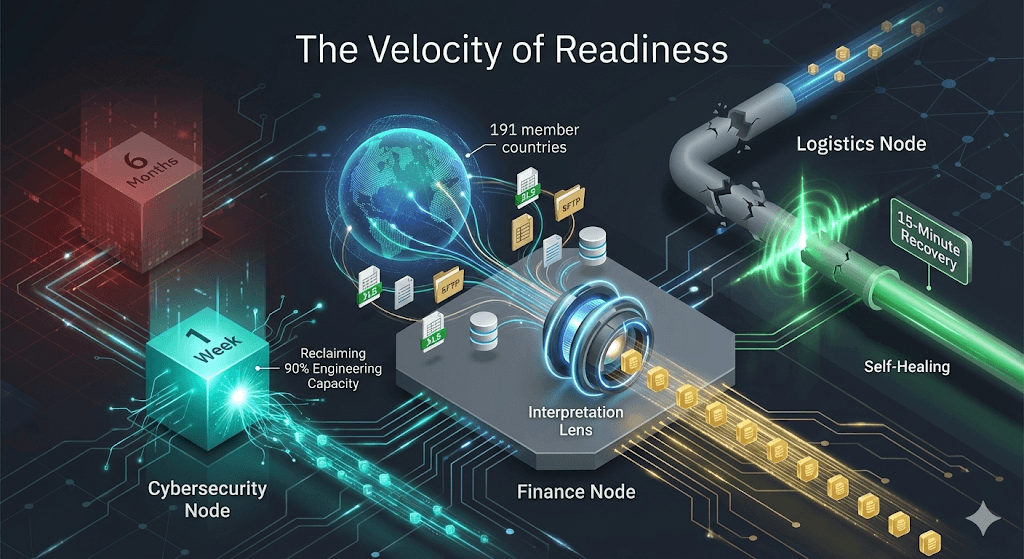
- Global Cybersecurity: A major security platform used to take six months to integrate a new data source. By automating the translation of their security logs, they cut that time to under one week. This move freed up 90% of their engineers to work on actual security threats instead of fixing broken data pipes.
- International Finance: A global institution managing data from 191 different countries stopped forcing every nation to use the same rigid templates. Their new foundation interprets the meaning of the data regardless of the format—whether it’s a modern database or an old spreadsheet.
- Logistics & Cargo: A major carrier with over 200 data pipelines found that even small changes in vendor formats caused days of downtime. By using a self-healing foundation, they turned these outages into 15-minute approval tasks.
The Architecture of the Future: The Logic and the Engine
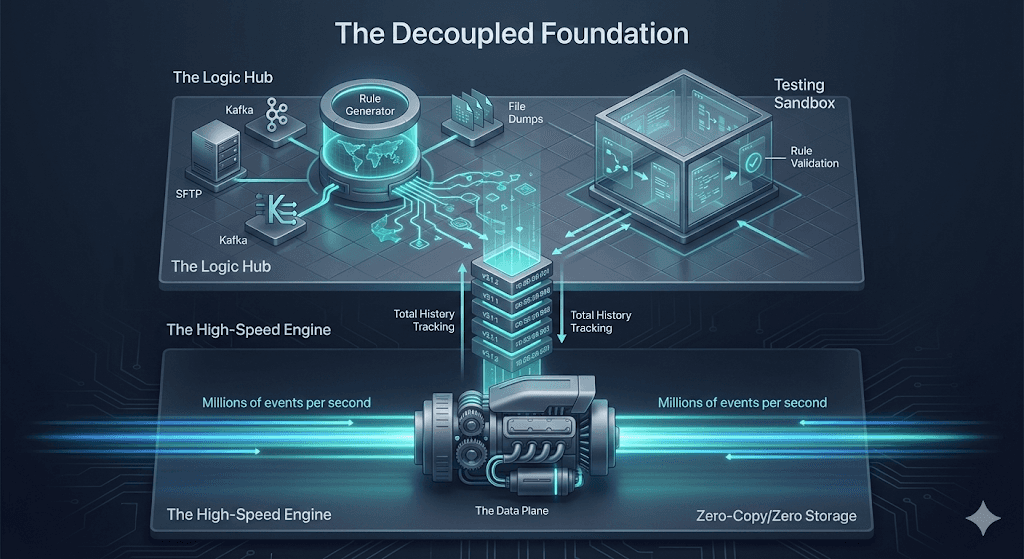
The best path forward is to separate the Rules from the Processing.
- The Control Plane: This part of the system analyzes your data (from Kafka streams to file dumps) and generates the necessary rules automatically. It creates a "Sandbox" where every new rule is tested against your business goals before it goes live.
- The Data Plane: This is the high-speed engine. It moves data at millions of events per second with zero storage, ensuring your systems always have the most current information without creating another "data swamp."
This setup gives you Total History Tracking: you know exactly where every data point came from and which version of the rules transformed it.
Action Plan: Building Sovereignty in One Quarter
The window to build a reliable foundation is closing. If you want to be ready for the next wave of automation, you need a 90-day plan.
- Phase 1: Map the Chaos. Use automation to scan your existing data and identify the 10% of format changes that are causing 90% of your current outages.
- Phase 2: Deploy the Common Language. Stop hand-coding connectors for every new tool. Establish a universal translation layer that decouples your business logic from your data processing.
- Phase 3: Set Rules as Code. Implement automated governance. Ensure that sensitive information is only accessible when specific security keys are present, moving security into the data path itself.
The bottom line is simple: Stop mapping data objects manually.
Building this internally is often a trap. The long-term cost to maintain a custom solution is usually 5x higher than using a specialized foundation. Reclaim your engineering talent, secure your data, and build the infrastructure that turns raw information into a business asset. The winners of the next decade will be the leaders who solved the problem of data readiness today.
Works cited
- The Data Platform Crisis Hiding Behind AI: Why you have 6 months to pivot | Subhadip Mitra, accessed January 4, 2026, https://subhadipmitra.com/blog/2025/agent-ready-data-platforms-sarp/
- A CIO Must Read - The Real Cost of Manual Data Operations - Edgematics, accessed January 4, 2026, https://www.edgematics.ai/a-cio-must-read-the-real-cost-of-manual-data-operations/
- Is MCP Holding Back Your AI Agents? See the Code-First Fix That Scales - Geeky Gadgets, accessed January 4, 2026, https://www.geeky-gadgets.com/mcp-context-rot-and-token-bloat/
- Model Context Protocol (MCP) at First Glance: Studying the Security and Maintainability of MCP Servers - arXiv, accessed January 4, 2026, https://arxiv.org/html/2506.13538v2
- What Is Automated Data Mapping? Benefits, Examples & Tools for 2025 - Domo, accessed January 4, 2026, https://www.domo.com/glossary/automated-data-mapping
- The Enterprise Guide to Modern Data Pipelines | EM360Tech, accessed January 4, 2026, https://em360tech.com/tech-articles/modern-data-pipelines
- Manual Data Entry Costs U.S. Companies $28,500 Per Employee Each Year - Parseur, accessed January 4, 2026, https://parseur.com/blog/manual-data-entry-report
- Universal Semantic Layer: The missing link in enterprise AI Success, accessed January 4, 2026, https://www.strategysoftware.com/blog/universal-semantic-layer-the-missing-link-in-enterprise-ai-success
- Data Readiness Is the Secret Weapon for Successful AI Agents - Workday Blog, accessed January 4, 2026, https://blog.workday.com/en-us/clean-data-is-the-key-to-every-successful-ai-initiative.html
- Ensuring Reliability in AI Agents: Overcoming Drift and Inconsistencies | by Kuldeep Paul, accessed January 4, 2026, https://medium.com/@kuldeep.paul08/ensuring-reliability-in-ai-agents-overcoming-drift-and-inconsistencies-ed878c57155e
- The Impact of Prompt Bloat on LLM Output Quality - MLOps Community, accessed January 4, 2026, https://mlops.community/the-impact-of-prompt-bloat-on-llm-output-quality/
- LLM Context Management: How to Improve Performance and Lower Costs - 16x Eval, accessed January 4, 2026, https://eval.16x.engineer/blog/llm-context-management-guide
- Understanding Schema Drift | Causes, Impact & Solutions - Acceldata, accessed January 4, 2026, https://www.acceldata.io/blog/schema-drift
- How AI Data Entry Automation Cuts Manual Processing by 70% - Datagrid, accessed January 4, 2026, https://datagrid.com/blog/automate-data-entry-ai
- The AI Readiness Paradox: The Agentic Value Gap And The Agentic Operational Model, accessed January 4, 2026, https://www.forbes.com/councils/forbestechcouncil/2025/12/22/the-ai-readiness-paradox-the-agentic-value-gap-and-the-agentic-operational-model/
- Mitigating Token Bloat in MCP: Reducing Schema Redundancy and Optimizing Tool Selection · Issue #1576 - GitHub, accessed January 4, 2026, https://github.com/modelcontextprotocol/modelcontextprotocol/issues/1576
- Building sovereignty at speed in 2026: Why CIOs must establish AI and data foundations in 120 days, accessed January 4, 2026, https://www.cio.com/article/4098933/building-sovereignty-at-speed-in-2026-why-cios-must-establish-ai-and-data-foundations-in-120-days.html
- Build vs. Buy Data Pipeline: The Definitive 2025 Decision Guide - Improvado, accessed January 4, 2026, https://improvado.io/blog/build-vs-buy-etl
- 11 Agent-Based AI Automation Statistics: Essential Data for Production AI in 2025, accessed January 4, 2026, https://www.typedef.ai/resources/agent-based-ai-automation-statistics
- Agentic AI in Action: 5 Data Readiness Steps You Should Know | B EYE, accessed January 4, 2026, https://b-eye.com/blog/agentic-ai-data-readiness-steps/
- Data readiness is the key to agentic AI success | NTT DATA, accessed January 4, 2026, https://services.global.ntt/en-us/insights/blog/data-readiness-your-first-step-to-agentic-ai-success